
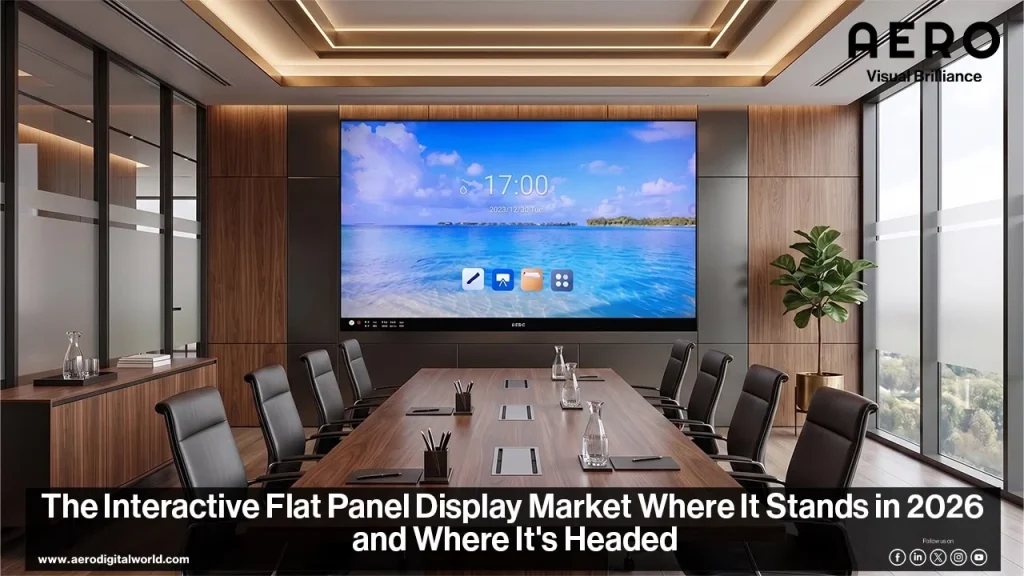
Interactive Flat Panel Displays (IFPDs) have moved well past the “smart classroom gadget” phase. They now sit at the center of how schools teach, how enterprises run meetings, and how governments modernize public infrastructure. What started as a whiteboard-and-projector replacement has become a full computing platform, 4K touch, built-in Android, wireless casting, and increasingly, AI-assisted collaboration, all packed into a single screen.
The Market, By the Numbers
Sizing this market depends heavily on which analyst firm you ask and how tightly they define “IFPD” versus the broader “interactive display” category but the direction is consistent across every source.
- Global IFPD market estimates for 2026 range from roughly $6.2–6.8 billion, with most forecasts projecting the market to reach somewhere between $9.6 billion and $11.4 billion by the early 2030s, at CAGRs generally clustering between 4.6% and 8.9% depending on scope.
- Broaden the lens to the full “interactive display” category (which includes kiosks, tables, and video walls alongside flat panels), and the numbers jump significantly. One estimate puts this segment near $60 billion in 2026, growing toward $125 billion by 2034.
- Shipment data tells a more tactile story: large-format IFPD units shipped in the millions per year globally, with 65″, 75″, and 86″ panels accounting for over 90% of shipments, and touch-enabled panels making up roughly 88% of all units sold a clear signal that touch is no longer a premium feature, it’s the baseline expectation.
Asia-Pacific Is the Engine Room
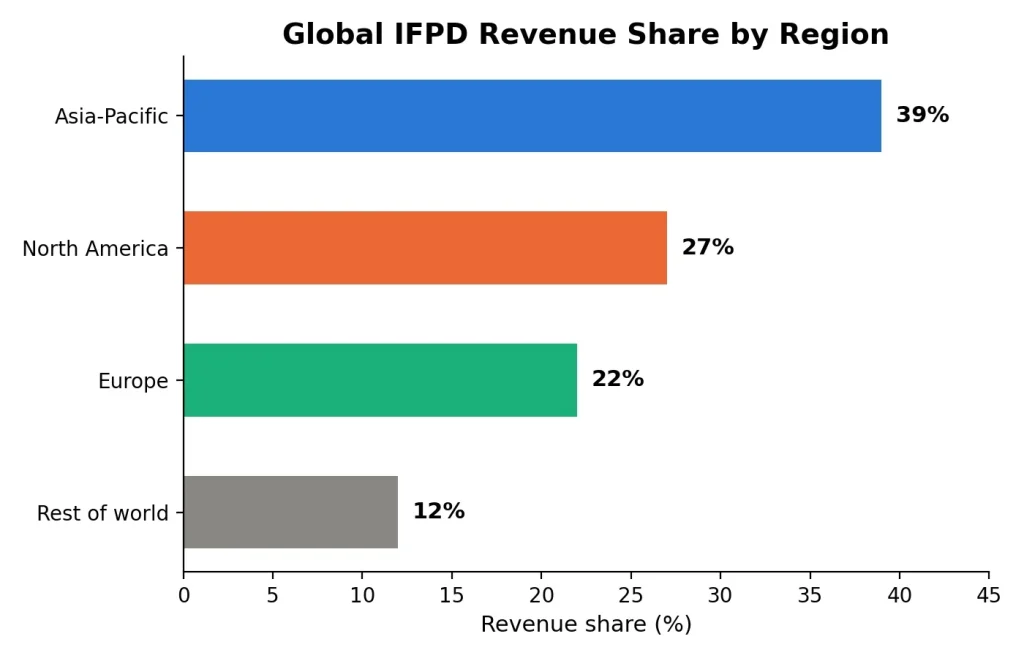
If there’s one consistent theme across every report, it’s this: Asia-Pacific is where the volume is. The region holds roughly 38–40% of global IFPD revenue, driven by three forces, large-scale government-funded digital education programs, rapid enterprise digitization in urban commercial hubs, and a manufacturing base concentrated in China that keeps hardware costs falling.
The India Story: Fast Growth, Still Early Innings
India’s IFPD trajectory is one of the more interesting sub-plots in this market:
- State-level digital school programs are estimated to have procured 1.4 million+ IFPD units between 2022 and 2025, a massive public-sector demand pull.
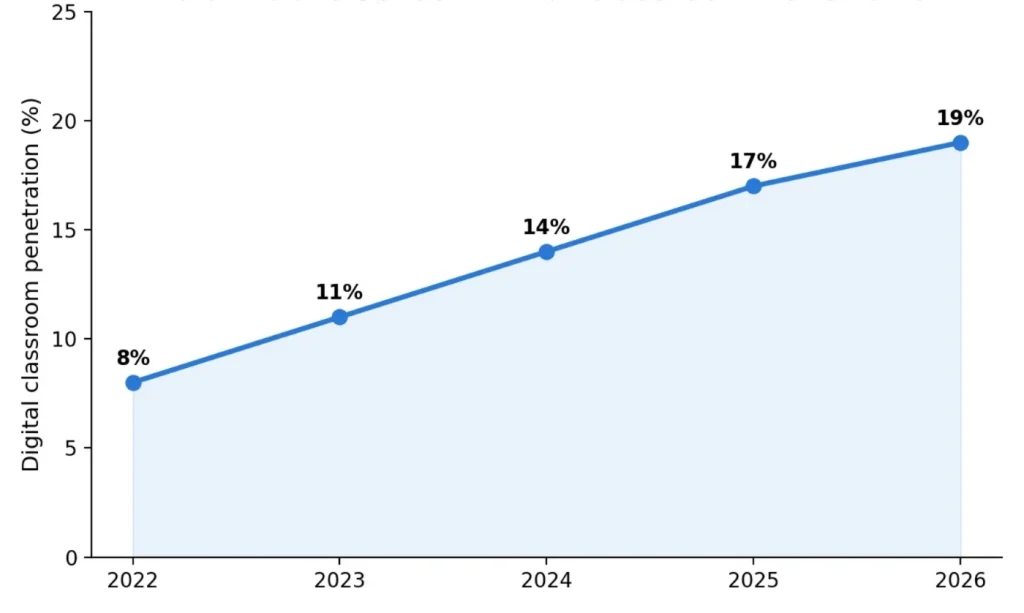
- Despite that, only around 19% of public schools had digital classrooms as of the most recent data available, which tells you the addressable opportunity is still largely untapped rather than saturated.
- India has also seen an estimated $720 million in combined private and government-backed funding flow into digital education infrastructure.
- On the corporate side, brands are competing hard for boardroom and training-room budgets, alongside a fast-growing set of India-based and China-origin brands competing primarily on price and after-sales service.
The net effect: India isn’t a market where demand needs to be created, it needs to be captured. Government tenders, school procurement cycles, and enterprise hybrid-work upgrades are all pulling in the same direction simultaneously.
What’s Actually Driving Demand
A few structural trends explain why this market keeps compounding rather than plateauing:
- Education digitization mandates. Education alone accounts for roughly 45–50% of total IFPD revenue globally and it’s policy-driven rather than discretionary, which makes it comparatively recession-resistant.
- Hybrid work becoming permanent. Corporate boardrooms and training rooms have shifted from “nice to have” video conferencing setups to baseline infrastructure, especially as encrypted, secure collaboration features become standard requirements in regulated industries like banking.
- Replacement cycles. IFPDs are displacing legacy projector-and-whiteboard combinations, and as early-generation IFPDs (installed during the first COVID-era digitization wave) reach end-of-life, a genuine replacement cycle is starting to layer on top of new demand.
- Falling hardware costs. Panel prices have been on a steady downward curve, making 4K multi-touch displays accessible to price-sensitive segments smaller schools, coaching institutes, SMEs that were priced out a few years ago.
- AI and software differentiation. As hardware commoditizes, the real competitive battleground is shifting to software built-in whiteboarding suites, AI-assisted note capture, device management, and integration with existing collaboration ecosystems (Teams, Zoom, Google Workspace).
Where AERO’s Smartvue Fits In
This is exactly the market AERO Digital Smartvue IFPD range is built for. With education and corporate sectors driving significant demand for interactive displays, Smartvue combines purpose-built technology, collaboration features, and support to address the evolving needs of modern classrooms, boardrooms, and institutions. AERO’s wider portfolio including Bizvue kiosks, Pitchvue LED walls, and Framevue also enables organizations to create integrated AV and digital signage solutions.
AERO has further differentiated Smartvue by introducing a 115-inch IFPD, one of the largest interactive flat panels available in India at the time of launch. Designed for large boardrooms, auditoriums, lecture halls, and control rooms, the larger format delivers greater visibility and impact than conventional 75″–86″ panels, strengthening AERO’s position in the premium IFPD segment.
The Bottom Line
The IFPD market isn’t a hype cycle, it’s a structural shift in how classrooms, boardrooms, and public spaces present and interact with information. Growth is steady rather than explosive at the global level, but pockets like India are still in the early stages of a much longer adoption curve, with government policy, falling costs, and replacement demand all pointing the same direction. For solution providers, the opportunity is shifting from “sell the panel” to “own the room”, hardware, software, and service bundled as one integrated deployment. With Interactive Flat Panel Display hardware, software, and service bundled as one integrated deployment, supported by long-term service and smarter digital collaboration.