
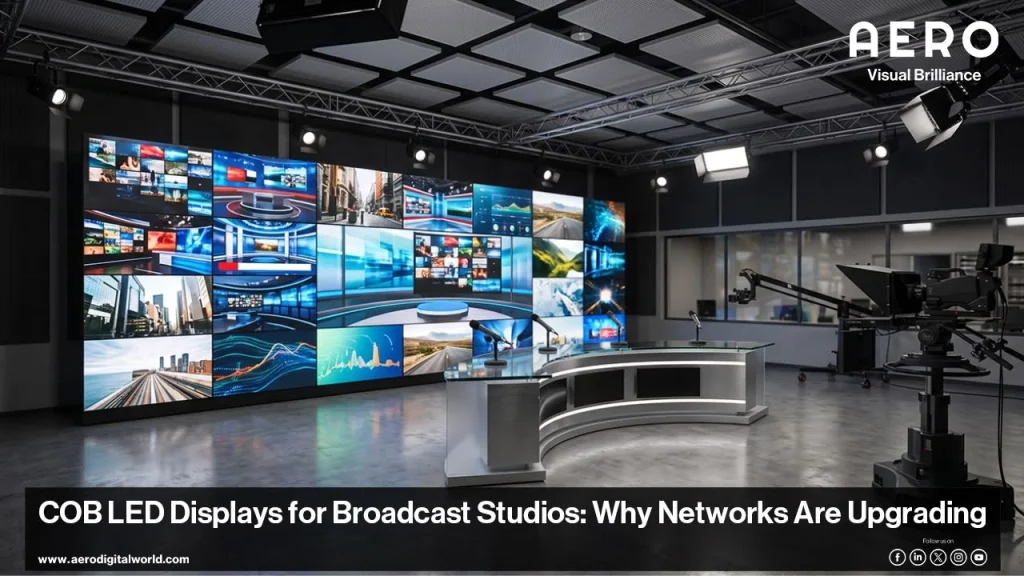
An expert guide to Chip-on-Board LED technology for newsrooms, sports desks, weather sets and virtual production stages.
Introduction
The broadcast studio has changed more in the last decade than in the previous thirty years. What used to be a set built around painted backdrops, chroma-key green screens and a handful of monitors is now a fully digital environment. Producers want visuals that move, react and pull the viewer into the story. That shift has forced networks to rethink the single most visible part of any set: the display.
For years, LCD video walls and projectors did the job. They filled the space behind the anchor and gave weather and sports teams something to point at. But on camera, their weaknesses show quickly — seams between panels, hot spots from projector lamps, colour that drifts under studio lighting, and glare that fights the very light designed to flatter presenters.
This is where COB LED technology has become the new standard. Chip-on-Board displays remove the visible gaps, hold colour under intense lighting and stay reliable through long broadcast days. As a specialist in COB LED display solutions, AERO DIGITAL works with studios that want a wall the camera loves, not one it has to work around. This guide explains what the technology does, why networks are upgrading, and how to choose the right screen for your studio.
Table of Contents
| Section | Description |
| Introduction | Why broadcast studios need better display technology |
| What is COB LED Display Technology? | Understanding Chip-on-Board displays |
| Challenges with Traditional Studio Displays | LCD and projector limitations |
| Benefits of COB LED in Broadcast Studios | Image quality, durability, reliability |
| Applications | Newsrooms, sports, virtual production, weather studios |
| Why TV Networks Are Upgrading | Business and technical reasons |
| How COB LED Improves Camera Performance | Refresh rate, colour and moiré control |
| Choosing the Right COB LED Display | Buying guide |
| Why Choose AERO DIGITAL | Brand expertise |
| FAQs | Common questions |
| Conclusion | Final thoughts |
What is COB LED Display Technology?
COB stands for Chip-on-Board. Instead of packaging each tiny LED individually and soldering it to the board — the method used in traditional SMD screens — COB mounts the bare red, green and blue chips directly onto the circuit board and covers them with a single protective resin layer. The result is a smooth, glass-like surface rather than a field of exposed diodes.
That construction changes what the display can do:
- Fine pixel pitch. Chips sit far closer together, enabling sub-millimetre pitches and razor-sharp images at close viewing distances.
- Higher brightness and contrast. A tighter light source produces punchy highlights and genuinely deep blacks, so on-screen graphics stay legible under studio lights.
- Wide viewing angles. Colour and brightness stay consistent even when the camera shoots the wall from a steep side angle.
- No visible LED gaps. The flat resin surface removes the pinhole texture that can shimmer on camera.
- Improved durability. The sealed surface resists dust, moisture, knocks and repeated cleaning — a real advantage on a busy set.
AERO’s own COB series delivers pixel pitches from roughly 0.6mm to 1.87mm, up to 8K resolution and HDR10 support, with a contrast ratio in the 20,000:1 to 40,000:1 range. Those numbers matter because a broadcast wall is judged by the lens, not the naked eye.
Why Traditional Broadcast Displays Are Becoming Outdated
Older display methods still work, but on camera their limits are hard to ignore. Broadcast engineers upgrading a set usually list the same frustrations.
- Visible bezels. LCD video walls join multiple panels together, and the seams between them cut across graphics and lower-thirds.
- Projector maintenance. Lamps dim and shift colour over time, and rear-projection setups eat valuable studio floor space.
- Reflections and glare. Glossy LCD surfaces bounce studio lighting straight back into the lens.
- Limited brightness. Under full broadcast lighting, many LCD and projection surfaces look washed out on camera.
- Viewing-angle drop-off. Colour and contrast fade at wide angles, which is a problem when cameras move around a set.
- High running costs. Lamp replacements, panel matching and colour calibration add up over a screen’s life.
Top Benefits of COB LED Displays for Broadcast Studios
The clearest way to see the difference is a side-by-side comparison of the two technologies most studios choose between.
| Feature | COB LED Display | Traditional LCD Video Wall |
| Brightness | High and even; stays punchy under studio lighting | Can wash out under strong set lighting |
| Contrast | 20,000:1 to 40,000:1 with deep blacks | Lower contrast; blacks look grey on camera |
| Maintenance | Front-access modules; sealed, robust surface | Panel matching and periodic recalibration |
| Lifespan | Long service life with stable performance | Backlights and panels degrade sooner |
| Viewing Angle | Up to 170° horizontal and vertical | Colour and brightness shift at wide angles |
| Seamless Display | No bezels; one continuous surface | Visible seams between joined panels |
| Color Accuracy | HDR10, wide gamut, consistent colour | Colour can drift panel to panel |
| Reliability | Shockproof build; strong heat dissipation | More failure points over long duty cycles |
Applications of COB LED Displays in Broadcast Studios
A single COB wall can serve very different production needs. AERO’s COB series is already specified for broadcast and control-room environments, alongside retail, corporate and hospitality settings.
News Studios
A seamless backdrop keeps headlines, tickers and video packages crisp behind the anchor, with no bezels cutting through graphics. Content updates instantly as stories break.
Sports Broadcasting
High refresh rates keep fast motion — replays, live feeds, on-screen stats — smooth and flicker-free on camera, even during rapid cuts.
Election Coverage
Long broadcast hours demand reliability. A large COB wall handles live result boards, swing charts and multi-window feeds without downtime through the night.
Weather Broadcast
Bright, accurate colour makes maps, radar and forecast graphics readable, and presenters can interact with the display directly instead of relying on a green screen.
Virtual Production
For in-camera VFX and LED-volume work, COB walls act as a lit backdrop that reacts to the scene. Pair them with fine-pitch panels such as Pitchvue 4K fine-pixel-pitch displays to reduce moiré and hold realism close to the lens.
Corporate Broadcast Studios
In-house studios for town halls, investor updates and product launches gain a professional, branded backdrop that scales from a single presenter to a full panel.
Podcast Studios
Compact COB walls give video podcasts a polished, on-brand set that reads well on camera without dominating a small room.
Why Television Networks Are Upgrading to COB LED Displays
The move to COB is rarely about looks alone. Networks weigh technical gains against long-term cost, and the case usually stacks up.
- Better viewer experience. Seamless, vivid visuals raise the production value audiences see at home.
- 4K and 8K readiness. Fine pitch supports ultra-HD workflows as broadcast resolutions climb.
- HDR support. Wider dynamic range delivers richer highlights and shadow detail on air.
- Energy efficiency. COB construction can cut power draw by around 25% versus comparable setups.
- Lower maintenance. Fewer lamps and calibration cycles mean less time and cost off air.
- Long-term ROI. A durable wall with a long service life spreads its cost across years of use.
- Stronger branding. A flexible canvas lets a network refresh its on-air look whenever it likes.
- Flexible studio layouts. Modular panels adapt to curved, wrapped or multi-zone set designs.
- Improved camera performance. High refresh rates and clean colour reduce the artefacts cameras pick up.
- Reduced downtime. Front-access servicing keeps the wall running through a live schedule.
How COB LED Improves Camera Performance
What looks fine to the eye can fall apart through a lens. COB is built to satisfy the camera first, and that is where much of its value lies.
- Higher refresh rate. A high refresh rate removes the scan lines and banding that appear when a camera films a slower screen.
- No flickering. Stable output keeps the image steady during slow-motion and high-frame-rate capture.
- Better colour reproduction. Wide-gamut, HDR-ready colour matches broadcast standards more closely.
- Accurate skin tones. Consistent colour temperature keeps presenters looking natural, not tinted by the wall behind them.
- Lower moiré. A fine, uniform surface reduces the interference pattern that ruins shots of a screen.
- High grayscale. Deep grayscale performance preserves subtle gradients in graphics and video.
- HDR compatibility. Native HDR support carries highlight and shadow detail through to the broadcast signal.
How to Choose the Right COB LED Display for Your Broadcast Studio
Not every studio needs the same specification. Camera distance, budget and set design all shape the right choice. Use these factors as a checklist when comparing options.
| Buying Factor | Recommendation |
| Pixel Pitch | Match it to camera distance — fine pitch (roughly 0.6–1.2mm) for close-up shots; wider pitch for large, distant walls. |
| Brightness | Choose a level that holds up under full studio lighting without blooming on camera. |
| Refresh Rate | Prioritise a high refresh rate (3840Hz or above where possible) to eliminate on-camera flicker. |
| Color Accuracy | Look for HDR10 support, wide colour gamut and reliable colour uniformity across the wall. |
| Installation | Confirm the mounting, curve or wrap the design needs, plus cabling and calibration support. |
| Service Support | Ensure local, responsive support and front-access maintenance to minimise downtime. |
| Warranty | Check the coverage term and what it includes for panels, modules and the control system. |
| Resolution | Specify a canvas that meets your 4K or 8K production and future-proofing goals. |
Why Choose AERO DIGITAL
AERO DIGITAL World is an Indian display-solutions specialist serving retail, corporate, hospitality, education and broadcast clients, with a portfolio spanning LED video walls, indoor LED display solutions and fine-pitch COB screens. For a broadcast studio, that breadth matters — the right wall depends on getting pitch, brightness and control exactly right for the camera.
- Premium COB LED displays. Flip-chip COB panels with fine pixel pitch, HDR10, wide viewing angles and a robust, sealed surface.
- Custom installation. Flat, curved and wrapped configurations tailored to your set design.
- Broadcast-focused solutions. Displays specified for broadcast and control-room use, not just general signage.
- Technical consultation. Guidance on pitch, refresh rate and controllers matched to your production workflow.
- Wide reach. A presence across 35+ cities with experience centres in Mumbai, Lucknow, Hyderabad and beyond.
- High-quality components. Precision PCB design, premium LED materials and Android or Windows control systems.
- Long-term service. Front-access maintenance and after-sales support to keep the wall on air.
- Customised studio solutions. End-to-end strategy, design and development for the space you actually work in.
Conclusion
Broadcast studios have moved on from bezels, projector lamps and colour that drifts under the lights. COB LED delivers what the modern set demands — a seamless surface, deep contrast, wide viewing angles, HDR colour and the high refresh rate a camera need. It also makes commercial sense: lower running costs, longer life and less downtime add up to a real return over the years a wall stays in service.
If you are planning a new set or upgrading an ageing video wall, the display is the one investment your audience sees every single day. To specify the right COB solution for your studio, contact AERO DIGITAL for a technical consultation and a screen built around your production.
Frequently Asked Questions (FAQs)
Q1. What is a COB LED display?
A COB (Chip-on-Board) LED display mounts bare LED chips directly onto the circuit board and seals them under a protective resin layer, instead of packaging each diode separately. This creates a smooth, seamless surface with fine pixel pitch, high brightness and strong durability — ideal for close-viewing environments such as broadcast studios and control rooms.
Q2. Why do TV studios use LED walls?
TV studios use LED walls because they deliver bright, seamless, high-contrast visuals that read well on camera. Unlike green screens, an LED wall lets presenters interact with live graphics in real time, updates content instantly, and gives the set a professional, immersive look that raises overall production value for viewers at home.
Q3. Are COB LED displays better than LCD video walls?
For broadcast, COB LED usually outperforms LCD video walls. COB offers a bezel-free surface, deeper contrast, wider viewing angles and higher refresh rates, so there are no visible seams or on-camera flicker. LCD walls are cheaper upfront but show panel joins, drift in colour and can wash out under studio lighting.
Q4. What pixel pitch is best for broadcast studios?
The best pixel pitch depends on how close the camera gets to the wall. For close-up shots and virtual production, a fine pitch of roughly 0.6mm to 1.2mm keeps the image sharp without moiré. Larger backdrops viewed from a distance can use a wider pitch. AERO’s COB range spans about 0.6mm to 1.87mm.
Q5. Can COB LED displays be used for virtual production?
Yes. COB LED walls are well suited to virtual production and in-camera VFX. Their fine pitch, high refresh rate and HDR colour create a realistic lit backdrop that reacts to the scene, while the seamless surface reduces moiré and keeps the image convincing even when the camera shoots close to the wall.
Q6. How long do COB LED displays last?
Quality COB LED displays are built for long, reliable service, often rated for tens of thousands of hours of operation. The sealed, shockproof surface resists dust, moisture and impact, while efficient heat dissipation protects the components. That durability makes COB a strong long-term investment for studios running long broadcast days.
Q7. Are COB LED walls energy efficient?
Yes. Flip-chip COB construction improves light efficiency and heat management, and can reduce power consumption by around 25% compared with comparable display setups. Lower energy use and less heat output help cut running costs and support sustainability goals across a facility that operates for long hours.
Q8. Do COB LED displays reduce camera flicker?
They do. COB LED displays support high refresh rates — often 3840Hz or higher — which eliminates the scan lines, banding and flicker that cameras pick up from slower screens. This keeps the image stable during normal capture, slow-motion replays and high-frame-rate shooting, which is essential for professional broadcast.
Q9. Are COB LED displays suitable for 4K broadcasting?
Yes. Fine-pitch COB LED walls support 4K and even 8K resolution, with HDR10 for wider dynamic range. That makes them ready for ultra-HD broadcast workflows, delivering the detail, colour depth and highlight control that modern 4K production and future-proofing require.
Q10. Why choose AERO DIGITAL for broadcast LED displays?
AERO DIGITAL specialises in premium COB and LED video-wall solutions, with panels specified for broadcast and control-room use. The company offers custom installation, technical consultation on pitch and refresh rate, high-quality components, front-access maintenance and support across 35+ cities — an end-to-end partner for studios upgrading their display.