
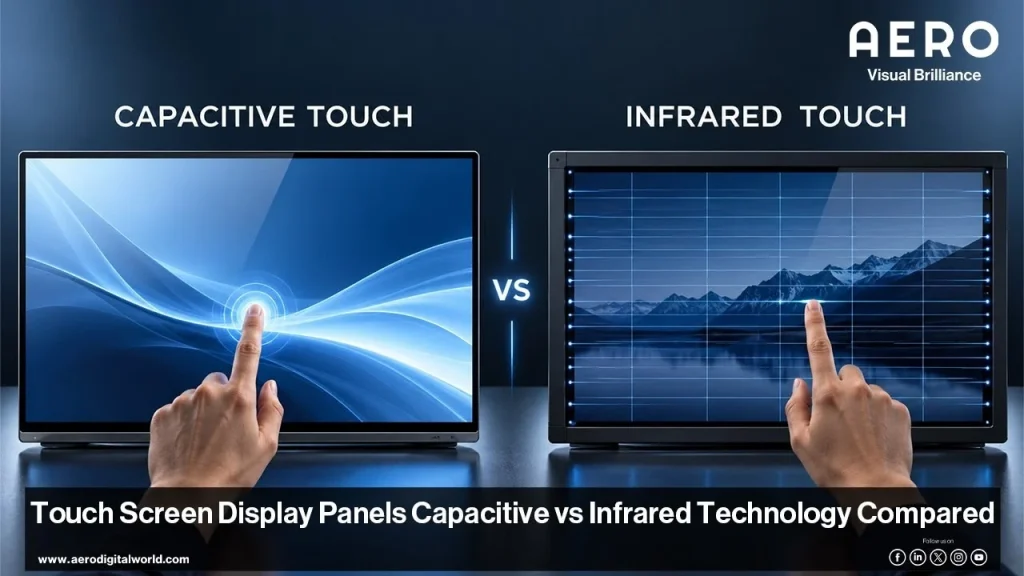
Touchscreens are currently an essential aspect of most modern device interaction. Right from industrial to commercial electronics, touch screen display panels have made device interaction easier. Most touch devices widely use resistive or capacitive display panel technology. Since, technology is unlikely to show signs of decline any time soon, many are also exploring latest solutions, such as the infrared touch screen display panel. It is primarily considered for specialised applications.
However, the question arises- how does a capacitive touch screen display panel stack up with an infrared technology display panel. The shortest answer is: choose a projected capacitive screen for smartphone-like and sleek precision where multi-touch is essential. Go for an infrared touch screen display panel when building industrial interfaces, large-scale displays or even outdoor directories where users might wear heavy gloves.
To get an end-to-end comparison between the two types, this guide will walk you through these two hardware technologies in detail.
What is a Capacitive Touchscreen?
Capacitive touchscreens are able to detect the input through changes in electrical charge. Our finger or a conductive stylus creates a disrupts the electrostatic field of the panel. This is registered as a touch by calculating the exact coordinates of this disruption instantly.
Key features include-
- It is accurate and highly responsive
- Also supports multiple touch gestures
- Offers superior clarity
- Enhanced durability and speed
- It needs bare finger interaction or special conductive stylus or gloves
Capacitive display technology finds its application is various industrial, medical and consumer electronics. It is preferred for its sleeks profile, high resolution and durability.
When evaluating capacitive touch screen display, consider factors like:
- Screen responsiveness
- Multi-touch capability
- Glare reduction technology
- Water and dust resistance (IP ratings)
- Compatibility with various gloves or stylus accessories
There has been a significant advancement in project capacitive technology. It has extended functionality even further and enabled operation in demanding conditions or through protective glass.
What is an Infrared (IR) Touchscreen?
The infrared touch screen display panel utilises a grid of invisible infrared light beams that are projected across the screen surface. When bare finger, stylus or gloved hand touches the surface, it blocks the IR beams. That’s when the system calculates the precise touch location through triangulation algorithms.
Key features are:
- Offers high optical clarity
- Works with any opaque object, like finger, stylus glove etc.
- Response time is fast
- Supports multiple simultaneous touch
- Affordable option for large devices
IR systems require thicker bezels often. That is why it could be vulnerable to dust, water or light interference. It is generally less precise compared to capacitive options. IR technology, unlike capacitive systems, operates with virtually any opaque object. This makes it more flexible.
The factors to consider when choosing IR display panel are:
- Size and bezel depth compatibility
- Touch point count and latency
- IP rating
- Environmental Factors and Installation Requirements
Which One Fits Your Environment?
Choosing between the right hardware is strictly dependent on your deployment environment. When setting up an outdoor wayfinding kiosk, an interactive classroom whiteboard or a factory floor control panel, infrared panel is your safest bet. It can easily scale up in size affordably, registers inputs in any condition and also survives heavy physical abuse.
Contrarily, a capacitive technology is suitable when you are designing a sleek self-checkout terminal, an interactive retail exhibit, an advanced medical device etc. This hardware provides intuitive and rapid multi-touch experience to users.
Making an informed decision when choosing the right panel prevents early hardware failure and poor user adoption. Whether you need rugged durability or sophisticated multi-touch capabilities, Aero Digital provides customisable digital display solutions engineered specifically for your operational demands.
FAQs
Which is the most durable type of touch screen technology?
Infrared is usually more rugged for heavy-use areas. Since the touch sensors are present in the outer bezel and not on the glass itself, severe surface scratches will never compromise the touch capabilities. Capacitive screens can fail when the internal conductive layer is severely damaged.
Can infrared touch screens operate under thick gloves?
IR technology depends on breaking a physical light beam and not on electrical conductivity. You can use a plastic pen, thick winter gloves or a wooden stick to operate an IR panel flawlessly.
Are capacitive screens water-resistant?
Mostly the standard capacitive screens are less effective with heavy water as the droplets may imitate the electrical conductivity of a human finger. Nevertheless, specialised industrial capacitive screens should be used for complete waterproof outdoor performance.
Which panel is cheaper for large interactive displays?
Infrared technology usually scales up faster and affordably compared to a capacitive panel. IR offers a major cost advantage for digital signage, directories or large interactive whiteboards.
Why does an IR screen register a touch before making an actual contact?
The invisible light grid is present marginally above the physical glass. The system logs the tough instantly just when an object breaks the beam only millimetre before hitting the screen surface.