
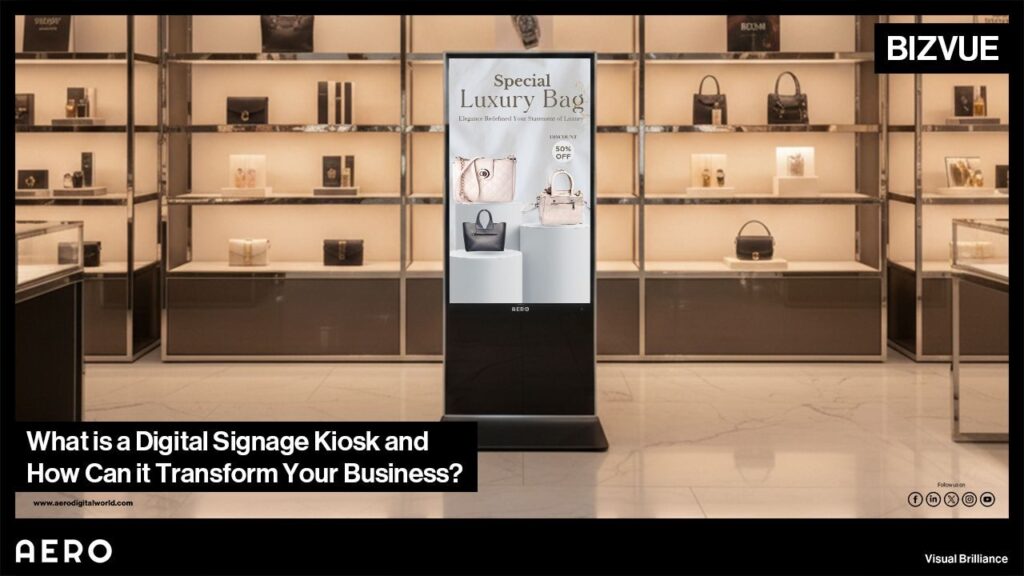
First impressions count, and in the digital-first economy today, businesses have seconds to grab customers’ attention. Flyers, static boards, and posters simply don’t work anymore to get noticed in an oversaturated marketplace. Today’s consumers expect real-time, interactive, and dynamic experiences anywhere they go.
They are the spaces where digital signage kiosks take center stage. They are sleek, contemporary, and extremely adaptable, revolutionising how brands engage with their customers. They don’t just show information; they engage, educate, and empower shoppers—to find the right product for a shopper, assist a traveler at an airport, or enable a hotel visitor to check in.
But what in the world is a digital signage kiosk, anyway? And most importantly, how can it revolutionize your business and customer experience? Let’s dive in.
Understanding Digital Signage Kiosk:-
A digital signage kiosk is a free-standing digital display terminal for presenting information, advertising, interactive services, or wayfinding solutions. Unlike billboards or posters, these kiosks utilize dynamic digital display and frequently touch-screen interaction to engage with users.
They are available in a broad range:
- Interactive kiosks – enable clients to view menus, maps, product catalogs, or orders.
- Non-interactive kiosks – show offers, announcements, or branding messages.
- Wayfinding kiosks – guide clients around malls, hospitals, or large corporate campuses.
- Self-service kiosks – make transactions such as ticket booking, bill payment, or self-checkout.
In essence, a digital signage kiosk is not itself an exhibit but a digital communications platform that integrates technology, content, and customer engagement.
Why Businesses are Moving Towards Digital with Signage Kiosks
The transition from traditional signs to electronic kiosks is not a trend; it’s a necessity that results from altered customer behavior. Customers today expect information on the spot, customized experiences, and do-it-yourself service. Electronic signage kiosks address all these demands to satisfaction.
Some of the compelling reasons to adopt are:
- High Interaction – Animated graphics, video, and interactivity engage so much better than static billboards.
- Flexibility – Content can be updated in real time with ease without the cost of reprinting.
- Efficiency – They reduce reliance on employees for everyday questions and tasks.
- Brand Image – High technology enhances brand image and credibility.
How Digital Signage Kiosks Can Transform Your Business
After that, here is the list of the revolutionary benefits these kiosks provide across industries:
1. Enhanced Customer Interaction
A static screen may go unnoticed, but an animated screen or interactive display won’t be able to. Digital signage kiosks are able to display product demonstrations, videos, and promotions that engage consumers for longer durations of time.
For instance:
- At a shopping mall, a kiosk can allow customers to search through colors, sizes, or promotions.
- At a restaurant, digital menus provided by kiosks allow one to order conveniently and quickly.
- This provides a dynamic and interactive experience, therefore enhancing customer satisfaction.
2. Better Sales and Revenue
Electronic kiosks can be unobtrusive salespersons. They can:
- Upsell or cross-sell based on suggestions.
- Display time-limited offers and facilitate impulse purchases.
- Promote offers and loyalty programs.
Digital signage sends recall to brands by more than 80%, and this directly impacts the buying decision. With smart locationing and interactive displays, companies can sell more conveniently.
3. Real-Time Sharing of Information
One of the most useful aspects of digital signage kiosks is that they can be updated in real-time.
- Airports can update flight status information.
- Hospitals can put up patient waiting times.
- Banks can inform customers about new promotions or wait times.
This does away with paper media and allows customers to always get the latest information, as accurately as possible.
4. Cost Savings on Marketing and Communication
Though there is a high cost of initial investment for kiosks, savings are returned within the blink of an eye by reducing printing, labor, and logistics costs.
Instead of printing and producing dozens of thousands of posters or leaflets, on-screen changes can be made to details within minutes. Holiday offers, product releases, or business news can all be distributed to sets of kiosks at the same time, economically and consistently.
You May Also Like:
How an effective kiosk design enhances user experience
5. Efficient Operations
Kiosks for digital signage can do the work that would otherwise be done by human staff.
Examples:
- Automated retail store kiosks minimize waiting lines.
- Ticketing kiosks at cinemas or transport hubs introduce efficiency.
- Hotel front-desk workload is minimized by information kiosks.
This leaves staff to concentrate on more remunerative customer interactions as the kiosk handles repetitive inquiries and tasks.
6. Customer Insights and Data Gathering
Electronic kiosks have analytics and AI-powered solutions in most cases. They can monitor customer interactions, preferred products, and busiest hours.
In the case of a kiosk in a mall, it can observe what the most trending promotions are being looked at. That data can be used in the process of optimizing advertising and personalization, and that leads to better ROI.
7. Improved Brand Perception and Modern Appeal
The digital kiosks make your company look modern and customer-centric. The customers expect a brand that runs on modern tech, and it gives a sense of sophistication and reliability.
Airport, high-end chain store, or neighborhood restaurant, accepting kiosks is a sign of an innovative culture and increased customer convenience.
8. Multiple Uses in Multiple Industries
Digital signage kiosks belong to no specific industry; they can be used in many ways in many industries:
- Retail – Product flyers, self-service checkout, and promotions.
- Hospitality – Check-in stations, event calendars, or wayfinding signage.
- Healthcare – Patient registration, line management, or health education materials.
- Education – Campus directories, announcements, or electronic libraries.
- Corporate Offices – Internal communication, visitor management, or announcements.
- Transportation – Ticketing, route information, and electronic maps.
Such cross-platform compatibility renders kiosks a long-term business investment of any size.
Digital Signage Kiosk vs. Traditional Signage
To understand the evolution better, let’s take a comparison:
| Feature | Traditional Signage | Digital Signage Kiosk |
| Content Type | Static images/text | Dynamic videos, animations, interactive content |
| Update Flexibility | Requires reprinting | Real-time updates with software |
| Customer Engagement | Passive | Highly interactive and engaging |
| Cost Over Time | Repetitive printing costs | One-time investment, lower long-term costs |
| Data Collection | None | Tracks interactions and provides insights |
| Brand Image | Standard | Modern, tech-savvy, innovative |
You May Also Like:
What Are the Top 5 Benefits of LED Video Walls for Retail Advertising?
Steps to Implement Digital Signage Kiosks in Your Business
If you’re considering investing in kiosks, here’s a roadmap to ensure successful integration:
- Define Your Objective – Is it for marketing, wayfinding, sales, or customer service?
- Choose the Right Type – Interactive, non-interactive, or self-service based on your need.
- Choose Quality Hardware – Touch screens, touch support, and robust kiosks.
- Employ Powerful Software – To book, organize, and analyze content.
- Build Great Content – Animations, video, and interactivity.
- Where to Position Them – Position in busy locations for maximum exposure.
- Track and Measure – Use data insights to maximize ROI and maximize content.
Future of Digital Signage Kiosks
Along with evolving times and technological advances, digital signage kiosks will only grow more powerful with the integration of features like:
- AI personalization – Showing targeted messages according to demographics.
- Mobile app integration – For end-to-end omnichannel interaction.
- Voice and gesture control – To simplify accessibility.
- Cloud and IoT integration – For smarter management and scalability.
The next few days will witness kiosks emerging as a crucial point of interaction between customers and business entities, and therefore a requirement.
Conclusion
An electronic signage kiosk is not merely a display screen—it’s an intelligent device that can revolutionize your business. With technology and customer-focused design, kiosks maximize interaction, drive increased sales, optimize operations, and create brand equity.
Irrespective of whether you own a chain retail shop, healthcare unit, or corporate space, investment in digital signage kiosks future-proofs your business and is customer-centric.
We are experts at offering advanced digital signage solutions tailored to your business requirements at Aero Digital World. Our kiosks are not mere grabbers but also return generators.
It is time to step out of the static mode and embrace a dynamic, interactive future. Are you prepared to revolutionize your company with digital signage kiosks? Contact Aero Digital World today and witness the difference technology can make.